Special Considerations for Participants Who Do Not Speak English: Translations
All consent forms and other participant materials must be in a language easily understood by the participant, and all translations must be approved by WCG IRB. If you are enrolling non-English speaking participants, you must have plans for conducting the consent discussion in the language understandable to the participant, and for ongoing communication with the participant throughout the research and in case of emergency. Sites may, for example, ensure at least one member of the research team is fluent in the language, and that research staff member(s) will be available during emergencies, or ensure the research team has 24-hour access to a translation service with sufficient medical expertise to discuss the research. Sites and study teams are asked on the translations request form to acknowledge “The research team will involve individuals fluent in both English and the language spoken by the person providing consent to ensure that information provided will be understandable, and that the research team will conduct ongoing communication in the language spoken by the person providing consent throughout the research and in case of emergency.“
Additionally, WCG expects the plans to obtain translations to remain consistent throughout the progress of the study; for example, if WCG-facilitated translations are requested at initial review, WCG expects to facilitate all translations for the remainder of the study.
Translations Considerations for Initial Screening of Medical Records
Sites may review medical records in a non-English language. Sites can use a certified third-party translator vendor service and may request redaction of items which are not necessary for the screening process. This activity does not require submission to the IRB (note that investigators should ensure they have appropriate HIPAA authorizations or other appropriate authorization to review the records).
Translations Considerations
WCG will process translations requests as received, unless otherwise noted by the sponsor/CRO. WCG recommends sites confirm with their sponsor/CRO if translation arrangements have already been made and which translations they should proceed with. WCG IRB will not be held financially responsible for translation service bills that the sponsor will not pay on behalf of sites. WCG IRB requires written confirmation that an invoice will be accepted should it need to be redirected to another party for payment. Sponsors/CROs can request WCG place site translation requests on hold for sponsor/CRO authorization. WCG will not provide translations for non-WCG IRB sites. WCG does not require back-translations for approval of translated documents. If there is an urgent need for translations, please refer to WCG’s policy on Short Forms in this guide.
1. Translations Facilitated by WCG IRB
WCG IRB can facilitate and provide translated study materials upon request. The chart below outlines the translations process when WCG facilitates the translation. Please note, once approved English documents are sent to the translator, the translations process cannot be stopped.
| For Documents That Have Not Been Previously Translated | For Documents That Have Been Previously Translated and are Modified | |
|---|---|---|
| How and When to Submit | Each request for translation must be requested by selecting the appropriate translations request option in ClinSphere® eReview Manager and answering all questions (IRBNet clients should use the WCG IRB Translation request form available in their IRBNet library). | WCG IRB staff will automatically initiate translations after changes are made to the English version via a change in research submission and are approved by the IRB. If translations are not needed for a submitted change in research, indicate “no” to the Change in Research Submission form question “Will you need translated documents or approval of translated documents?” when the change to the English document is initially submitted for review. |
| IRB Process | 1. English documents are reviewed and cannot be translated until approved. 2. Approved English documents are sent to a qualified translator to be translated. Once sent to the translator, the translations process cannot be stopped. 3. Translated documents and their corresponding Certificate of Translations are received from a translator. 4. The translated document(s) and their corresponding translations certifications are sent to an IRB member for approval. | 1. Updates to English documents are reviewed and approved first. 2. WCG IRB staff check to see if the corresponding change in research submission form indicates “no” for “Will you need translated documents or approval of translated documents?” If “no” is selected, WCG will not proceed with translations. 3. If the CIR form does not indicate a translation is not needed, the approved English documents are sent to be translated. Once sent to the translator, the translations process cannot be stopped. 4. Translated documents and their corresponding Certificate of Translations are received from translator. 5. Translated documents are sent to an IRB member for approval. |
| Turn Around | 7-10 business days to translate documents. 3-5 business days to review and approve translated documents. |
| Billing | WCG IRB bills an administrative fee for translation services in addition to the translator’s fee. Translation costs vary depending on the volume and complexity of the translation request. WCG does not provide quotes. |
2. Translations Facilitated by Sponsors, CROs, and/or Sites (including AI-facilitated translations)
Sponsors, CROs, and sites can facilitate their own translations of WCG IRB English approved documents. The translations must correspond to the WCG IRB approved English versions; therefore, a translation of the sponsor template consent form, for example, or any materials not yet approved by WCG IRB are not acceptable. If the sponsor/CRO/site is facilitating translations, it is their responsibility to arrange translations for updated materials with their vendor, and then submit the updates to WCG IRB for review. The chart below outlines the translation process when translations are facilitated by the sponsor, CRO, or site.
| For Documents That Have Not Been Previously Translated and Reviewed | For Documents That Have Been Previously Translated and Reviewed | |
|---|---|---|
| How and When to Submit | Sponsor/CRO/site translations cannot be submitted at the time of the initial review of the English documents (via initial review submission or change in research submission of new documents). WCG IRB must approve the English version of the materials before the sponsor/CRO/site translates them. Translated documents can be submitted to WCG IRB by selecting the appropriate Translations request option in ClinSphere® eReview Manager and answering all questions (IRBNet clients should use the WCG IRB Translation request form available in their IRBNet library) after English approvals are granted. Note: AI algorithms can be used to generate automated translations. However, the translation thereafter requires review by certified translator as an accurate representation of the approved English version. | Updated translated documents should be submitted to WCG IRB by selecting the appropriate Translations request option in ClinSphere® eReview Manager and answering all questions (IRBNet clients should use the WCG IRB Translation request form available in their IRBNet library) after English approvals are granted. It is expected that you submit updated translated materials within 30 days of the English document approvals. |
| FOR ALL DOCUMENTS | |
|---|---|
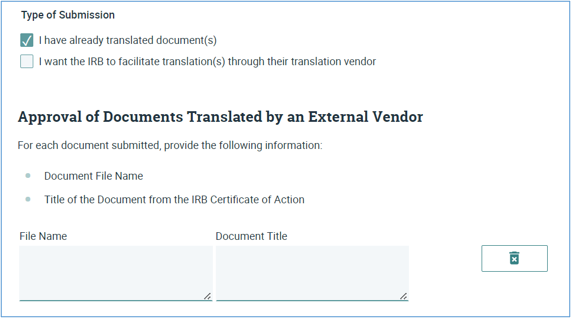
| Submission Requirements | 1. Submit via the translations request option in ClinSphere® eReview Manager (IRBNet clients should use the WCG IRB Translation request form available in their IRBNet library). 2. Provide the translated materials. Consent forms must be submitted in Word-compatible format (PDF not accepted). The format of the translated material must match its English counterpart exactly. 3. Provide a Certificate of Translation that includes the following: — a. Document title of the English approved document as it appears on the IRB Certificate of Action. — b. IRB approval date of the English approved document; or version number and date; or consent form codes (i.e. S0-1; IN0-0, etc.). — c. IRB tracking number and/or sponsor protocol number. — d. Sponsor — e. PI Name — f. Source and Target languages — g. A statement confirming that the translator is fluent in English and the target language, or otherwise able to translate. — h. A statement confirming that the document is an accurate representation of English. — i. For first-time review of a translated document, a certificate of translation attesting to tracked changes-only will not be accepted. The translator must attest to the accuracy of the entire document(s). 4. Ensure one of the following methods are used for WCG staff to be able to accurately match each translated document with its corresponding WCG English IRB approved version. — a. Complete this section on the Translation Request Submission Form completely and accurately,(see image below table). The Document Title should be referenced from the Certificate of Action of the approval of the corresponding English document. — b. Include the WCG IRB English Document title or the IRB document identifiers directly on the translated document. |
| WCG IRB Process | 1. WCG IRB staff review the translated documents provided to ensure the formatting matches the English versions exactly (mirror copies), the content appears to align, and the corresponding Certificate of Translations appropriately identifies the translated documents (reference above). 2. WCG IRB staff send the translated documents package to an IRB member for approval. |
| Turn Around | 3-5 business days to review and approve translated documents. |
| Billing | WCG IRB bills a review fee per language and per submission and a distribution processing fee per language per PI. |
Short Forms
WCG IRB has the following policy regarding the use of a short form consent process to enroll participants. WCG’s policy may be more restrictive than federal requirements, and can only be applied in situations when both of the following are true:
- A full-length version of the consent form in language understandable to the participant is not available, or is not appropriate for the participant. This may include unexpected translations, low literacy, or visual impairment.
- It is in the participant’s best medical interest to be enrolled in the research, and for unexpected translations, before a translated consent form can be obtained.
Below are the steps required for WCG’s short form policy:
- Access the appropriate WCG Short Form Template here. For unexpected translations, use form HRP-503 in the appropriate language. For English speakers with low-literacy, visual impairment or similar situations, use form HRP-511.
- Insert study-specific information, including title of study, principal investigator, appropriate signature lines (copy from the IRB approved consent form or keep the appropriate template ones provided in the translated short forms, and contact information into the OHRP template short form.)
- Verbally review the information in the IRB approved long version of the consent form to the participant with an impartial witness. For unexpected translations, a translator who is fluent in both English and the participant’s language is required and the translator may serve as the witness.
- Obtain the following signatures:
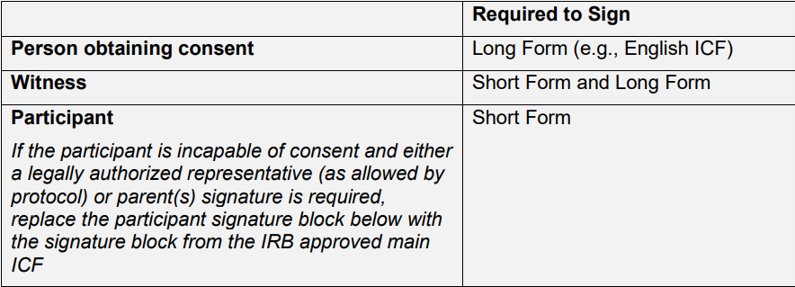
- Provide the participant signed copies of the IRB approved long form consent form and the short form in the language understandable to the participant.
- File the original signed IRB approved long form consent form and the original signed short form in the participant’s research record and medical record, if appropriate.
- For unexpected translations, the site must obtain a fully translated version of the IRB approved long form consent form at the earliest opportunity. The participant should be re-consented using the fully translated consent form within 60 (business) days or at the first visit after receipt of the translated consent form (whichever is less).
If the participant doesn’t meet the criteria above for the use of WCG’s Short form policy, but may need to be enrolled in emergent situations such as those listed below, researchers can plan to not enroll the participant, or refer to the appropriate regulations (for FDA, 21 CFR 50.24; for Non-FDA, 45 CFR 46.101(i)) to utilize the pathways for a waiver of a consent.
- Subjects are unable to give their informed consent as a result of their medical condition.
- The intervention under investigation must be administered before consent from the subject’s LAR is feasible.
- There is no reasonable way to identify prospectively the individuals likely to become eligible for participation in the clinical investigation.